

Construction Data Challenge: Environmental Reporting Starts Early Content

Construction companies generate significant amounts of operational information every day. Fuel purchases, equipment utilization, material deliveries, water and dewatering activities, soil movements, waste diversion, subcontractor activities and project records all contribute to understanding how work is performed.
Yet when that information is needed for environmental reporting, what should be a straightforward process can become surprisingly complicated. The challenge is rarely that the information doesn't exist. It's that the information was collected for different purposes, stored in different places and managed by different people.
As environmental reporting becomes more relevant to procurement decisions, RFPs, RFQs and bid submissions, customer expectations and business performance, construction companies face an important question: How do we turn the information we already collect into something reliable, consistent and useful?
The answer begins long before the report itself.
Contractor qualification is another reason this information matters. ISNetworld describes sustainability services that help hiring clients collect and review contractor and supplier information, including greenhouse gas emissions, resource management and supporting documentation. The specific requirements vary by hiring client, but the direction is clear: reliable operational records can help contractors respond to sustainability-related information requests as part of customer and supplier relationships.
Construction Data Wasn't Designed for Environmental Reporting
Unlike organizations operating from a single facility, construction companies manage activities across changing project locations, equipment fleets, suppliers and subcontractor networks.
Each project has its own operational requirements. Information may be captured through accounting systems, equipment management platforms, fuel cards, supplier invoices, project management tools or individual spreadsheets.
These systems serve legitimate business purposes. Accounting teams need accurate financial records. Project managers need visibility into schedules and resources. Procurement teams need to manage purchasing and supplier relationships.
Environmental reporting introduces another requirement: bringing relevant information together to understand emissions and other environmental impacts.
Consider something as routine as diesel consumption.
A company may have fuel purchasing records in its accounting system, equipment usage information in a fleet management platform and project and fuel-tank allocations maintained by individual site teams.
Each record may be accurate for its original purpose. But connecting those records to understand fuel-related emissions at a project or company level requires additional work.
This is where the data challenge begins.
Many sources, one defensible picture
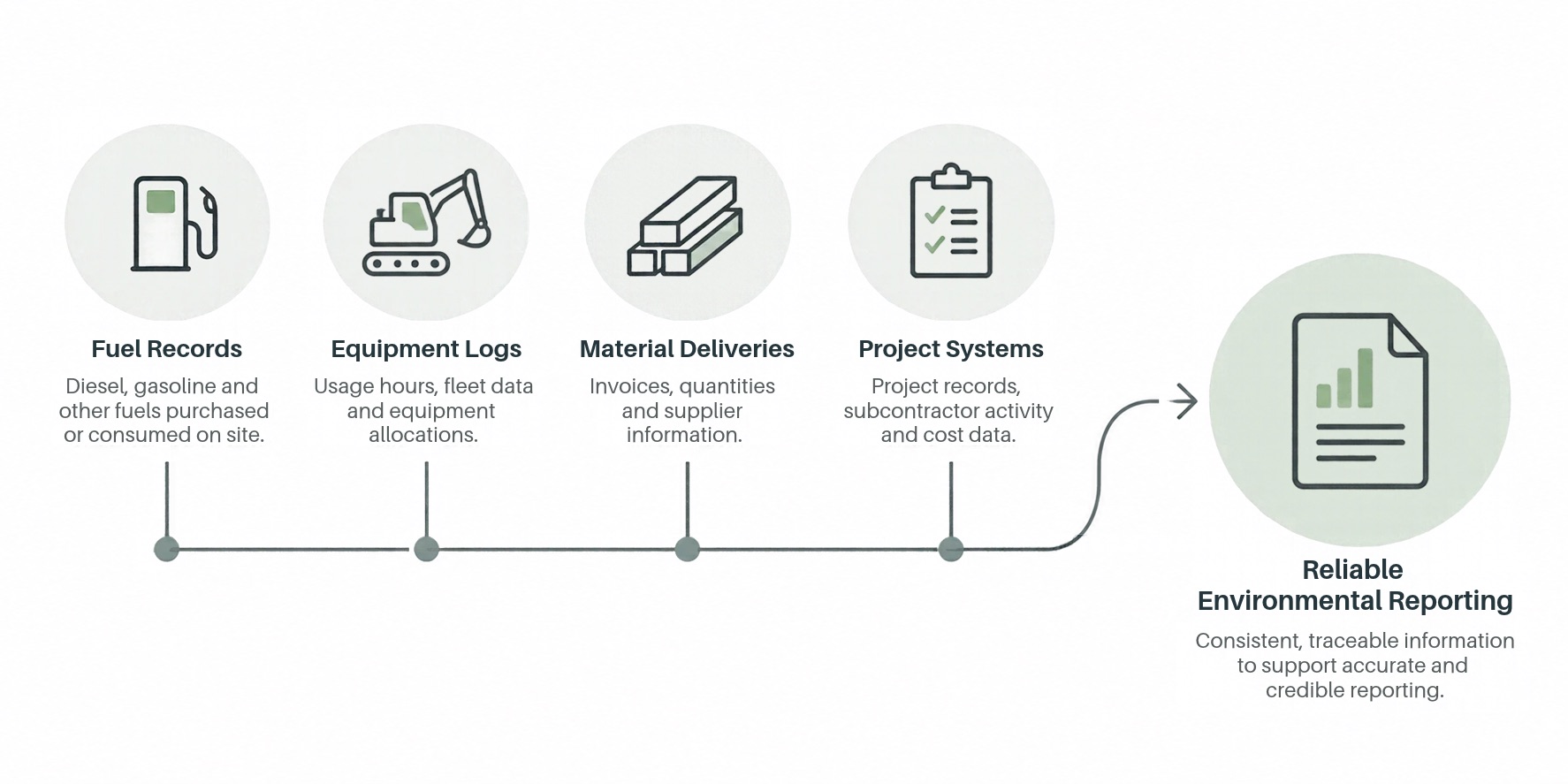
The Hidden Work Behind an Environmental Report
Environmental reporting is often associated with calculations, emissions factors and final disclosures.
In practice, much of the effort occurs before any calculation begins.
Someone must identify where the information resides, determine whether it is complete, confirm the reporting period and establish how individual records relate to the activities being measured.
For construction companies, this can involve several recurring challenges:
• Different information sources: Fuel, electricity, equipment and material records may be maintained in separate systems.
• Inconsistent reporting formats: One supplier provides detailed quantities while another provides only invoice totals.
• Unclear ownership: Information may be available, but responsibility for collecting and validating it has not been assigned.
• Missing project context: A transaction may be recorded accurately without identifying the project or activity it supports.
• Movement between projects: Equipment and other assets may move between sites without automated location tracking, making accurate project-level allocation more difficult.
• Supporting documentation: The original records needed to substantiate a reported figure may not be readily accessible.
None of these challenges necessarily indicates poor operational management.
They reflect the reality that most construction information systems were established to support project delivery, financial management and operational control rather than environmental disclosure. The difficulty emerges when organizations need those systems to answer questions they were not originally designed to address.
When Spreadsheets Become Part of the Risk
Spreadsheets remain useful tools for organizing information, performing calculations and supporting reporting activities. For many construction companies, they are a reasonable starting point. The challenge develops when environmental reporting becomes a recurring responsibility involving multiple projects, multiple geographies, contributors and reporting periods.
One project manager may maintain fuel records using one format or unit of measure while another uses a different structure. A sustainability coordinator may consolidate the information into a master workbook that requires still other units of measure for reporting. Updated figures may arrive after calculations have already been completed.
The concern is not simply whether a spreadsheet produces the correct calculation. It is whether the organization can explain where the underlying information originated, which assumptions were applied and whether the process can be repeated consistently.
For example, if a customer questions a reported emissions figure six months after submission, can the company identify the supporting records and explain how the result was calculated?
That ability to trace information back to its source is an important part of reporting confidence.
The goal should not be to eliminate spreadsheets simply because they are spreadsheets. It should be to recognize when the volume, complexity, accuracy, precision and frequency of reporting require stronger controls.
Reliable Reporting Depends on More Than Accurate Calculations
An emissions calculation can be mathematically correct while still producing an incomplete or misleading picture if the underlying information is inconsistent.
Consider a contractor reporting fuel consumption across several projects. If some projects provide complete fuel records while others report only purchases made through a particular supplier, the resulting totals may not represent the same operational boundaries.
Similarly, equipment rented for a project may be recorded differently from company-owned equipment, even when both contribute to the activities being assessed. These distinctions matter because environmental reporting depends on clearly defined boundaries, project-level detail, consistent methodologies and documented assumptions.
Reliable reporting therefore requires attention to several foundational practices.
Consistent definitions. Teams need a shared understanding of what information is being collected, which activities are included and how quantities should be recorded.
Clear responsibility. Individuals or functions should be accountable for supplying, reviewing and maintaining relevant information.
Source documentation. Supporting records should remain accessible so that reported information can be checked and explained.
Repeatable processes. The organization should be able to apply the same collection and validation approach across projects and reporting periods, with documented changes when methods evolve.
These practices are not unique to sustainability. They are familiar principles of sound operational and financial management. Environmental reporting simply creates another reason to apply them consistently.
Better Reporting Begins Closer to the Work
One of the most important shifts construction companies can make is to stop treating environmental reporting as an isolated exercise performed at the end of a reporting period.
Much of the information required originates with everyday operational decisions.
• Fuel is purchased.
• Equipment is assigned.
• Materials are delivered.
• Subcontractors complete work.
• Invoices are approved.
• Waste is diverted.
• Soil is moved on or off site.
• Water, dewatering and testing activities occur.
Each activity creates information that may later contribute to understanding environmental performance. When reporting requirements are considered only after those activities have occurred, teams may need to reconstruct information that could have been captured more consistently at the source.
This does not mean every project manager or site supervisor needs to become an environmental reporting specialist. It means the organization should understand where relevant information originates and establish practical ways to preserve its usefulness.
For example, adding a consistent project identifier to fuel records may improve the ability to allocate consumption across projects. Establishing a standard approach to collecting electricity consumption may reduce reconciliation work later.
Small improvements in existing processes can make a meaningful difference without introducing unnecessary administrative burden.
The most effective approach is one that supports the way construction teams already work.
Where Construction Companies Should Begin
Improving environmental data readiness does not require a complete transformation of existing systems. A practical starting point is to understand the information already available and identify where the greatest gaps exist.
Construction leaders can begin with five questions:
1. What information do we already collect? Identify existing records related to fuel, energy, equipment, materials and other activities relevant to the company's reporting needs.
2. Where does that information reside? Map the systems, departments, equipment, suppliers and project teams responsible for maintaining it.
3. Can we connect the information to the right activities? Determine whether records can be associated with specific projects, equipment, reporting periods or operational boundaries.
4. How do we know the information is reliable? Review completeness, consistency, supporting source documentation and the assumptions required to use the data.
5. What would make the process easier to repeat? Identify opportunities to standardize collection, reduce duplicate effort and improve accountability.
The answers provide a foundation for deciding where process improvements, training or technology may deliver the greatest value. They also help organizations avoid investing in reporting capabilities before understanding the operational information those capabilities depend upon.
From Reporting Obligation to Operational Insight
Environmental reporting may be the immediate reason construction companies begin examining their data more closely, but the potential value extends beyond producing a disclosure.
Consistent information can help organizations understand patterns in fuel consumption, identify gaps in project records and improve visibility into activities that influence both costs and emissions.
Not every environmental metric will translate directly into an operational improvement. However, better information creates opportunities to ask more informed questions.
Are similar projects using resources differently?
Are equipment records sufficiently complete to support meaningful comparisons?
Can the company explain changes in reported emissions from one period to another?
These are management questions as much as sustainability questions. The organizations that benefit most will be those that approach environmental information as part of broader operational discipline rather than an isolated reporting requirement.
The Report Is the Output. The Process Builds Confidence.
Environmental reporting is often judged by the final document, the figures it contains and the requirements it satisfies. But the credibility of that report was established much earlier.
It depends on the information captured across projects, the people responsible for maintaining it and the processes used to bring it together. For construction companies, the opportunity is not simply to produce another report. It is to develop a more consistent understanding of the activities taking place across the business.
And that begins long before anyone opens a reporting template.
Frequently Asked Questions
What environmental data should construction companies collect first?
The starting point depends on the company's activities, reporting boundaries and customer or regulatory requirements. Common sources include fuel consumption, purchased electricity, equipment usage and relevant material purchasing records. Companies should prioritize information that is material to their operations and required reporting objectives.
Why is emissions data difficult to collect across multiple construction sites?
Construction projects operate across different locations, teams, suppliers and systems. Information may be captured using inconsistent formats or without the project identifiers and supporting details needed for emissions reporting. This creates additional work when consolidating data.
Can construction companies use spreadsheets for environmental reporting?
Yes. Spreadsheets can be effective for smaller or less complex reporting activities. As reporting expands across projects and reporting periods, organizations should evaluate whether their processes provide sufficient consistency, traceability, version control and validation.
How can contractors improve the accuracy of their emissions data?
Contractors can improve data quality by establishing consistent definitions, assigning responsibility for information collection, retaining source documentation and implementing repeatable validation practices. Clearly documenting reporting boundaries and assumptions is equally important.
Who should be responsible for collecting environmental data on construction projects?
Responsibility is typically shared across operational and administrative functions. Project teams, procurement, accounting, fleet management and sustainability personnel may all contribute information. Clear accountability and coordination are essential to maintaining reliable reporting.
References and Supporting Sources
Greenhouse Gas Protocol. A Corporate Accounting and Reporting Standard (Revised Edition). Read source
Greenhouse Gas Protocol. Corporate Value Chain (Scope 3) Accounting and Reporting Standard. Read source
U.S. Environmental Protection Agency. Scope 1 and Scope 2 Inventory Guidance. Read source
ISN, Sustainability. Read source
Further Reading
-

Why Environmental Reporting Is Becoming a Business Priority for Construction Companies
Environmental reporting in construction is shifting from an occasional compliance exercise to a practical business capability. The companies that prepare now will be better positioned to respond to procurement requirements, understand their operations and provide customers with credible information.

