

Why Environmental Reporting Is Becoming a Business Priority for Construction Companies Content
The Conversation Is Changing
For years, environmental reporting was often discussed as a sustainability initiative. In construction, that description is becoming too narrow. Increasingly, environmental information is connected to the way projects are planned, materials are selected, suppliers are engaged and bids are evaluated.
Consider the direction of Canadian federal procurement. The Government of Canada’s Standard on Embodied Carbon in Construction establishes disclosure and reduction requirements for qualifying major projects. Amendments effective in September 2025 expanded requirements relating to steel and whole-building life-cycle assessments. The standard does not apply to every contractor or every project, but it demonstrates how environmental evidence can become part of project delivery expectations. [1, 2]
This matters because reporting requirements do not begin when a report is due. They begin when someone decides which information must be captured, who is responsible for it and how it will be verified.
The real challenge is operational, not just environmental.
A construction company may already have much of the information it needs, but not necessarily in one place. Fuel records may sit with operations, electricity data with facilities, materials documentation with procurement and project evidence with site teams or subcontractors.
The problem is rarely a lack of effort. It is the difficulty of connecting information gathered by different people, for different purposes, across multiple projects.
The challenge is not simply calculating emissions. It is bringing together information generated across job sites, equipment, suppliers and business operations in a way that is consistent, traceable and useful. That is where I believe construction companies have an opportunity to rethink their approach. Better reporting begins with better access to the underlying data.
FROM CONSTRUCTION ACTIVITY TO INFORMED DECISIONS
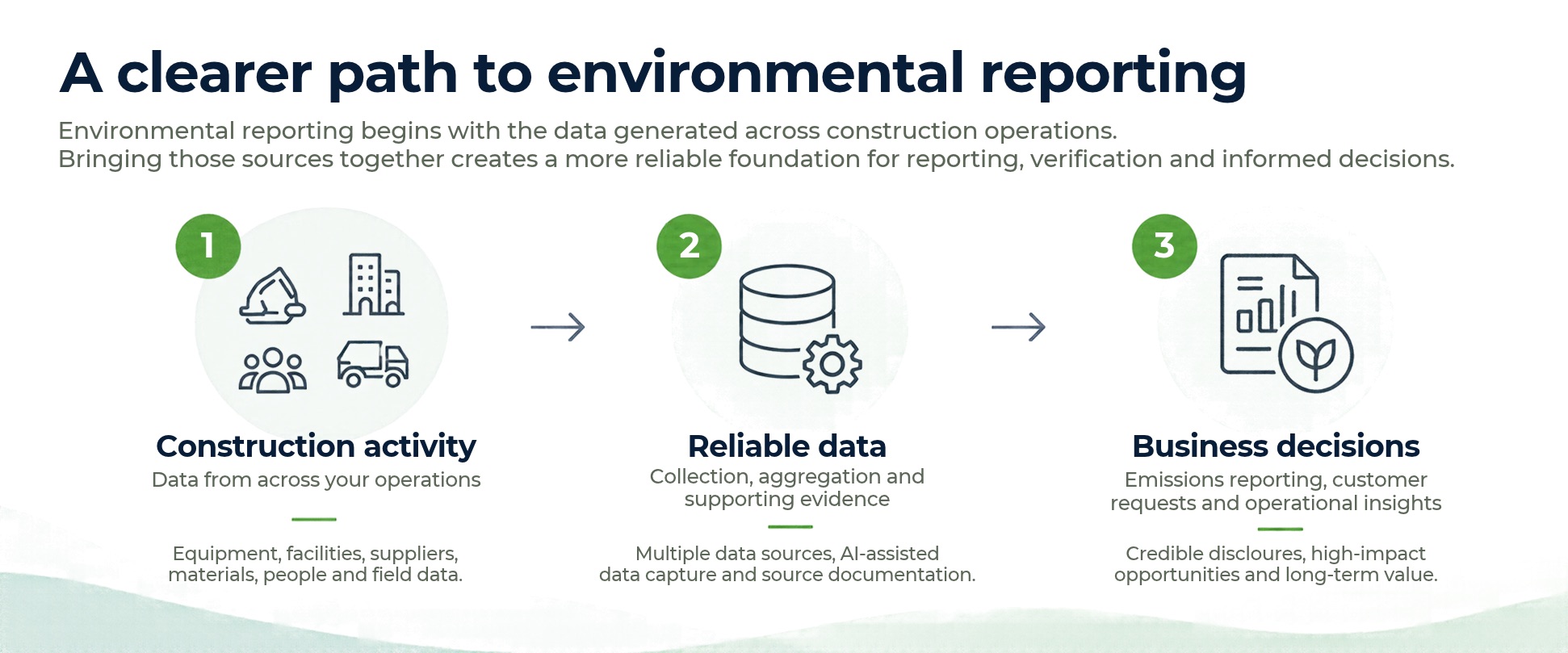
When those records are assembled only at reporting time, teams may spend valuable hours locating files, clarifying assumptions and checking whether the numbers are comparable. This is why I believe environmental reporting deserves attention at the leadership level: it is fundamentally a question of how an organization manages information.
Customer expectations are becoming more specific
It is important not to suggest that every construction company faces the same reporting obligations. Requirements vary by jurisdiction, project, customer and contract.
Yet the broader direction is clear. The Canada Green Building Council has documented the growing need for consistency in embodied-carbon reporting and the emergence of multiple policy and building-standard drivers. [3]
For contractors, that raises practical questions:
• Can we explain where a figure came from?
• Can we retrieve supporting records?
• Can we respond consistently when different customers request similar information in different formats?
These are questions of readiness and credibility as much as compliance.
Better environmental reporting begins with better data habits
The Greenhouse Gas Protocol distinguishes direct emissions from sources an organization owns or controls, emissions from purchased energy and other indirect emissions across its value chain. [4] In construction, applying these concepts depends on defining organizational and project boundaries carefully and collecting the right activity data.
No software platform can eliminate the need for sound judgment, clear responsibilities or credible source records. Technology can, however, help organizations establish repeatable processes rather than rebuild the same report from scratch.
I would encourage construction leaders to start with four questions: What are we being asked to report? Where does the underlying information originate? Who is accountable for its quality? And can we reproduce the answer when someone asks again?
Those questions are a more useful starting point than purchasing a tool simply because reporting feels urgent.
A business capability worth building
The opportunity extends beyond producing a disclosure. Reliable environmental information can support more consistent customer responses, better internal visibility and more informed conversations about materials, equipment and operations.
It may also help contractors prepare for bids and customer evaluations that request environmental evidence. That is not a promise of winning work. It is an argument for being prepared to answer the questions that increasingly accompany it.
At Nectivio, we work on the practical side of this challenge: bringing activity information together from the systems, documents and people already involved in day-to-day operations. Our Select platform supports mobile and in-field collection, aggregation across data sources and the retention of supporting records and images. These capabilities can make it easier for teams to prepare Scope 1, 2 and 3 information for review and reporting. The appropriate accounting methods, boundaries and verification processes still require careful human oversight.
The companies that make progress will not necessarily be those with the most ambitious statements. They will be those that can explain their numbers, show their evidence and improve their processes over time.
Where to start
If environmental reporting is beginning to surface in your customer conversations, start by identifying one recurring request and tracing the information needed to answer it. That exercise will reveal more about your readiness than a broad commitment without an operational plan.
Environmental reporting is becoming a business priority because the quality of the answer increasingly depends on how the business operates. The sooner we recognize that connection, the better prepared we will be.
Frequently asked questions
Why does environmental reporting matter to construction companies?
It can affect responses to customer and procurement requests, support internal operational understanding and provide evidence for applicable disclosure requirements.
Does every contractor have to report embodied carbon?
No. Obligations depend on the applicable jurisdiction, procurement framework, project characteristics and contract terms.
What should a construction company do first?
Identify the reporting requests it actually faces, define boundaries and responsibilities and assess the quality and accessibility of underlying project and operational data.
